New 12-month results: plant-based diagnostic cassettes show measurable breakdown

The research builds on the work of Okos Diagnostics co-founders Luis Fernando Sánchez Barrios and Sander Julian Brus, who co-authored the original Frontiers in Lab on a Chip Technologies study together with the research team at Helix Biogen Institute. The collaboration combines product development, sustainable materials and diagnostic expertise with field research under real environmental conditions. What happens to a rapid diagnostic test after it has been used?
For most lateral flow tests, the answer is simple: the plastic housing remains. Conventional diagnostic cassettes are typically made from fossil-based plastics designed for durability, but not for their end of life.
At Okos Diagnostics, we are exploring a different approach.
New 12-month field results from our collaboration with Helix Biogen Institute in Nigeria provide further real-world evidence of how our plant-based diagnostic cassettes change when exposed to tropical soil conditions over time.
From four months to a full year of real-world testing
Earlier this year, our research with Helix Biogen Institute was published in Frontiers in Lab on a Chip Technologies. The study evaluated Okos plant-based lateral flow cassettes under field conditions in Ogbomoso, Nigeria, using sandy, clayey and loamy soils.
The original four-month study documented early physical changes including moisture uptake, surface discoloration, deformation and microbial interaction. Conventional plastic controls, meanwhile, showed negligible change.
The experiment has now been followed for 12 months, allowing us to see how those early changes develop over a much longer period.
What happened after 12 months?
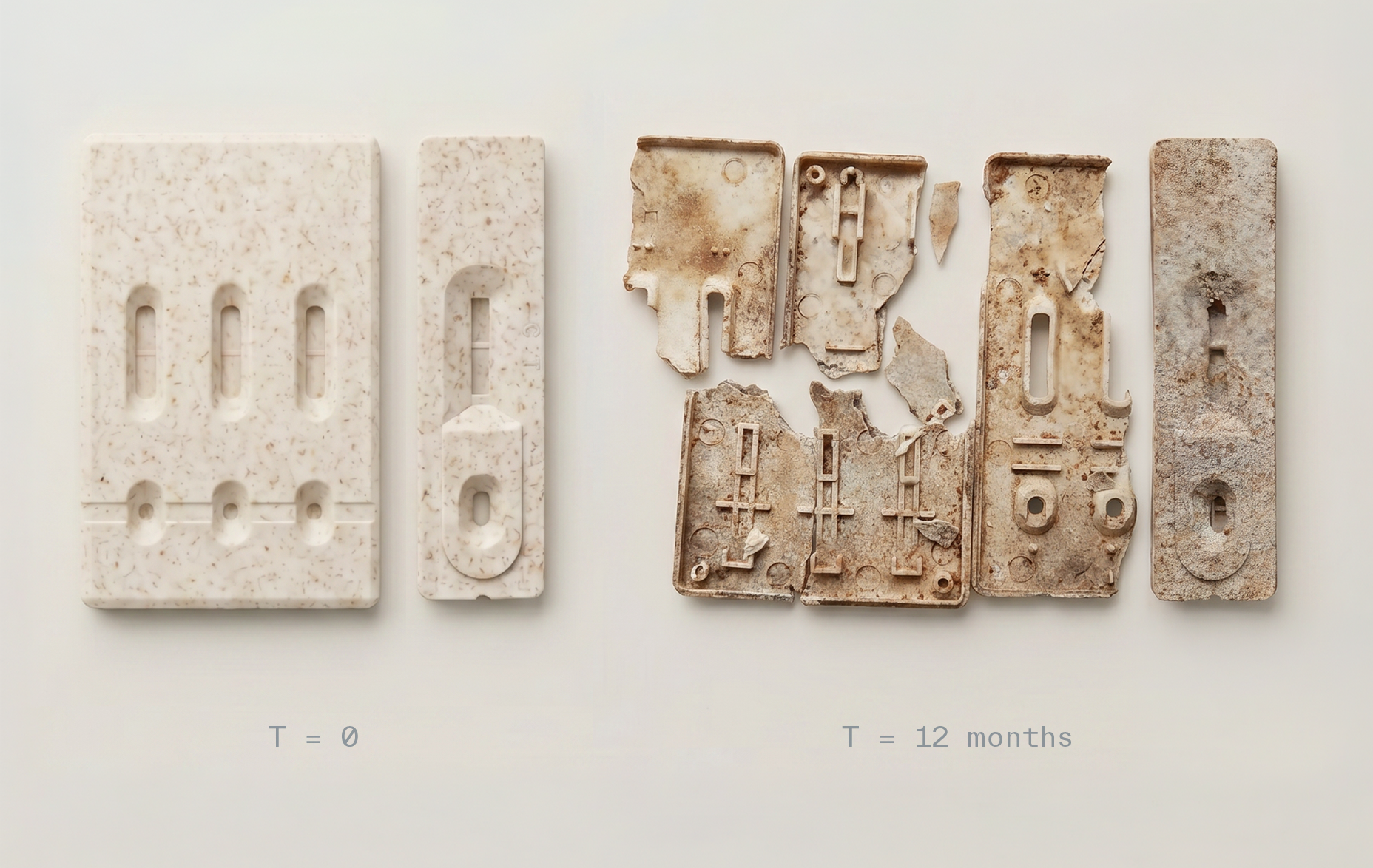
The new results show increasingly clear differences between the plant-based diagnostic housings and conventional plastic controls:
Around 20% mass loss in sandy soil, accompanied by cracking, brittleness and fragmentation.
A clear progression over time. Initial increases in weight were followed by measurable material loss, consistent with the earlier observation that moisture uptake can occur before structural breakdown becomes dominant.
Different behavior depending on soil type. Loamy soil produced the greatest early moisture uptake, while sandy soil resulted in the highest long-term mass loss.
No measurable mass loss or visible deterioration in conventional plastic controls over the same period.
The findings reinforce something already observed during the initial study: environmental conditions matter.
Soil composition, moisture, drainage, temperature and microbial activity can all influence how plant-based materials behave outside controlled laboratory conditions. The original Frontiers study similarly found substantial differences between sandy, clayey and loamy environments.
Why real-world material testing matters
Compostability standards and controlled laboratory testing remain essential tools for evaluating sustainable materials. But medical products do not always reach ideal end-of-life conditions.
Understanding how materials behave in the environments where they may actually end up is therefore an important part of developing more sustainable diagnostics.
The 12-month study does not demonstrate complete biodegradation, nor does mass loss alone establish what happens to every remaining fragment. Further monitoring and material analysis are needed to understand the complete degradation pathway.
Proper healthcare waste management also remains essential.
What these results do provide is measurable evidence that the plant-based cassette material is physically breaking down under real tropical soil conditions, while the conventional plastic controls remain largely unchanged.
That distinction matters.
Building evidence for more sustainable diagnostics
Rapid tests have become an essential part of modern healthcare, from infectious disease testing to home diagnostics. Their convenience and accessibility, however, also create large volumes of single-use material.
Our goal at Okos Diagnostics is to rethink one of the largest components of that waste stream: the diagnostic cassette itself.
The plant-based materials used in our cassettes are designed to reduce dependence on conventional fossil-based plastics while maintaining the mechanical properties required for diagnostic manufacturing and use. The materials evaluated in the original research were derived from renewable sources and designed in accordance with established compostability standards, including ASTM D6400 and EN 13432.
Twelve months in the soil does not give us every answer.
But it gives us something equally important: real-world evidence of what happens next.
We thank the team at Helix Biogen Institute and the Anesvad Foundation for supporting this ongoing research.
Another step toward diagnostic products designed not only for how they are used, but for what happens after they are used.



Comments